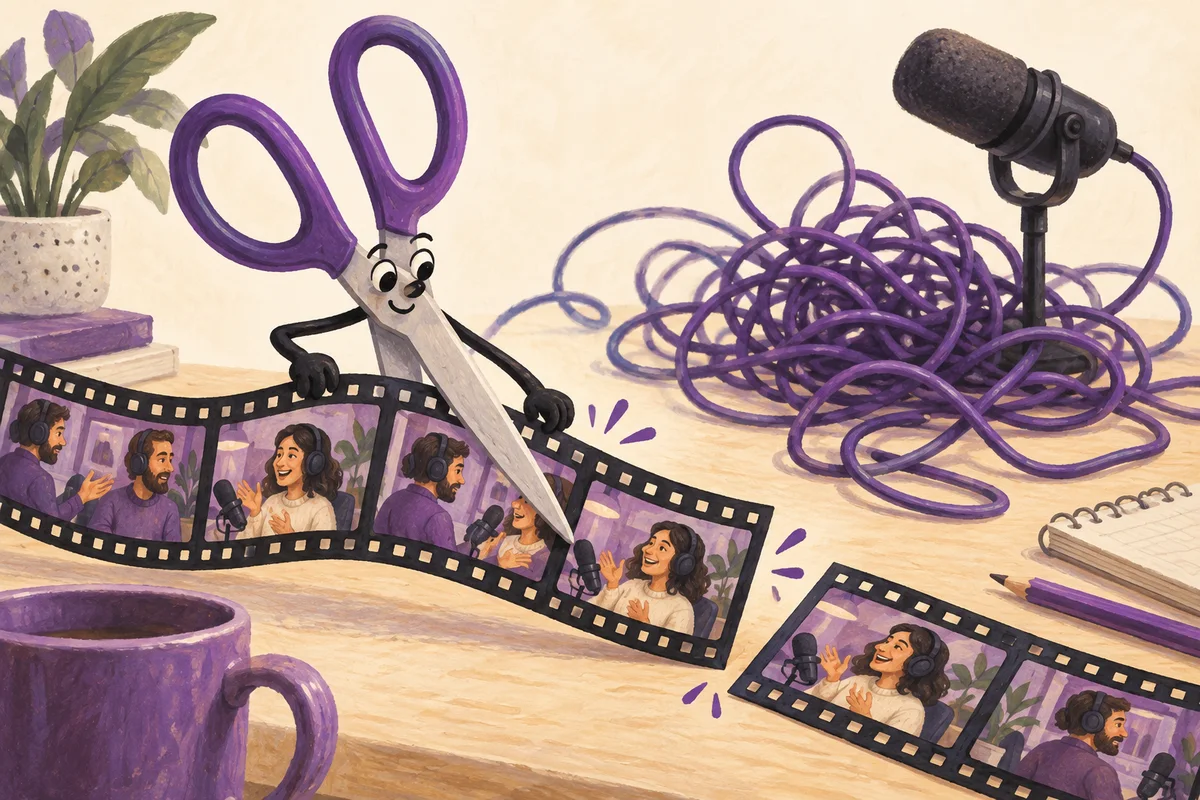
Choose podcast clips by scoring the clarity of the opening, the completeness of the idea, the value of the payoff and the context required. Then review the actual cut for accurate meaning, captions and framing. A moment that looks exciting on a timeline is not automatically a good standalone video.
A long conversation can contain excellent short clips, but it can also contain twenty seconds that make sense only after forty minutes of background. The job is to find complete, watchable ideas without turning a speaker's sentence into something they never meant. This guide gives you a practical selection sheet and a repeatable editing workflow.
Choose the purpose of the clips
Decide whether the clips should teach a specific idea, introduce a guest, answer a common question or invite people to the full conversation. Different purposes favour different moments. A useful explanation may be stronger for education than a dramatic reaction, while a short story may introduce a guest's perspective more naturally than a list of credentials.
Define the intended audience and what they already know. A technical discussion may need more context for a general audience than for specialists. This does not mean simplifying everything into a slogan. It means choosing excerpts that remain understandable to the people you want to reach.
Find candidate moments before polishing anything
Review the transcript or source recording and mark complete ideas, surprising examples, clear demonstrations and concise stories. Keep the start and end times with a note explaining why the moment is useful. At this stage, collect candidates rather than committing to the first section that sounds energetic.
Automated suggestions can help locate possibilities, but treat them as editorial leads. A score or suggested highlight does not know every nuance of your audience, permissions or publication context. Review the surrounding conversation before making a selection. The most important sentence may be the qualification immediately before the apparent hook.
Use a simple scoring sheet
Score each candidate against the same criteria. A small scale, such as one to three, is enough to compare options. Keep a short explanation beside the score so the decision remains understandable. The numbers organise judgement; they are not a formula that predicts reach or guarantees a viral result.
| Criterion | Strong candidate | Reason to revise or reject |
|---|---|---|
| Opening | The subject becomes clear quickly | Unexplained references or long setup |
| Complete idea | A viewer receives a coherent point | The answer ends before its conclusion |
| Payoff | A useful insight, example or story lands | Energy without substance |
| Context | Meaning survives outside the episode | A cut reverses or exaggerates the claim |
| Production | Usable sound and framing | Important speech or action cannot be understood |
Do not let a high total override a serious context problem. A misleading clip should be repaired or rejected even if it has an excellent opening. Editorial accuracy is a requirement, not a bonus point that can be traded for excitement.
Test the opening without inventing a new claim
A strong opening tells the viewer what the clip concerns and why it is worth watching. You can remove unnecessary delay, but preserve the words needed to understand the statement. Avoid replacing a nuanced discussion with a headline that claims certainty the speaker did not express.
If the excerpt begins with “that is why it failed”, the viewer needs to know what “it” refers to. You may need an earlier sentence, a concise contextual title or a different starting point. If the explanation becomes longer than the clip itself, choose another moment. Some sections belong in the full episode, and that is perfectly acceptable.
Keep the answer and its qualification together
Listen before and after the proposed excerpt. Check whether the speaker is describing a hypothetical situation, quoting someone else, making a joke or explaining an exception. A short cut can accidentally turn a conditional statement into general advice. Preserve the context that changes the meaning.
Be especially careful with numerical claims, personal stories and sensitive topics. Confirm that the edit does not imply an endorsement or conclusion absent from the source. Where a claim needs verification, check an appropriate primary source before using it in a promotional title or description. A tidy caption does not make an unsupported claim reliable.
Make a rough cut before designing the packaging
Create a simple cut with the intended beginning and ending. Watch it as a standalone piece, without the full transcript open. Does it answer a question or complete a story? Is there an abrupt reference to something missing? Fix the editorial structure before spending time on animations, music and colour treatments.
Ask a person who has not heard the episode what they understood. Their answer can reveal missing context faster than another hour of polishing. If they describe a different claim from the one the speaker made, review the boundaries of the excerpt. The edit should make the idea clearer, not more convenient.
Review captions word by word where meaning matters
Check names, technical terms, numbers and negations carefully. A missing “not” can do more damage than a dozen awkward line breaks. Make sure captions follow the spoken meaning and remain readable over the image. Avoid displaying so many words at once that the viewer spends the whole clip catching up.
If translating, use an appropriate language review for important material. A literal translation may miss an idiom or alter the tone. Keep the original context available to the reviewer. Do not present an automatic translation as professionally verified unless it has actually received that review.
- Confirm names and specialist vocabulary.
- Check numbers against the source recording.
- Keep sentence meaning intact across caption breaks.
- Review timing and contrast on a small screen.
- Check translated wording with the necessary expertise.
- Watch the final export, not only the editing preview.
Frame the person and the important action
A landscape podcast recording may need reframing for a vertical or square destination. Check that the crop follows the relevant speaker and does not remove meaningful gestures or demonstrations. When two people interact, a single close crop may lose the reaction that makes the exchange understandable.
Keep captions and key visuals clear of interface overlays on the intended destination. Test the exported file on a phone. Automatic reframing can be a useful starting point, but it still needs review when speakers move, lean out of frame or refer to objects. The camera should not appear to be interviewing the empty chair.
Worked example: choosing three clips from one episode
Imagine a fictional forty-minute interview about starting a small creative business. You mark eight candidate moments. One has a dramatic opening but depends on an earlier story. Another contains a clear three-step explanation. A third offers a short example of a mistake and what changed afterwards.
You score the candidates, reject the misleading standalone moment and select three with distinct purposes: a useful method, a concrete story and a thoughtful answer to a common question. Each gets a rough cut, context review and caption check. The titles describe the actual content rather than promising universal success.
The result is three complementary clips instead of three versions of the same point. You keep the source timestamps and editing notes so future revisions are easier. The process saves time by making the editorial decision before investing heavily in visual packaging.
Publish a coherent set without repeating yourself
Give each clip a clear title and description suited to its content. Where appropriate, link to the full conversation and identify the speaker accurately. Check that you have the necessary rights and permissions for the source material, music and any additional visuals. Ownership of one part of a recording does not automatically cover every asset added later.
Space the clips according to your actual publishing plan and capacity to respond. There is no universal schedule that guarantees performance. Review useful audience questions and available analytics, then choose one improvement for the next batch. Do not rewrite the whole strategy because one clip received a different response from another.
Keep an editorial archive
Store the source reference, selected timestamps, final export and any important permission or review notes together. Mark which clips have been published and where. This prevents accidental duplicate uploads and makes it easier to replace a caption error or update a description later.
Keep rejected candidates with a short reason if they may be revisited. “Needs context from earlier section” is useful; “bad clip” is not. Over time, the archive becomes a practical record of what works for your audience and production setup, without pretending that the same choice will suit every episode.
Frequently asked questions
Should I always choose the most emotional moment?
No. Choose a moment that serves the clip's purpose and remains accurate outside the full conversation. Emotion can support a strong idea, but it cannot replace context or a meaningful payoff.
Can AI select the final clips for me?
AI suggestions can help identify candidates. Review the source, meaning, permissions and final export yourself or with an appropriate editor. Automated scores should support judgement rather than replace it.
How many clips should one episode produce?
Use the number of distinct worthwhile ideas available. Forcing a fixed quota can create repetitive or weak clips. A smaller set of complete, useful excerpts may be a better result.
How does Clip Splitter fit?
Use Clip Splitter for its available video preparation and clipping tools, then apply this editorial review before publishing. The scoring sheet is a selection method, not a guarantee of reach or a claim that every suggested clip is ready to release.